

Board Performance · 2025
In this section12 topics
- Prevention of Conflicts of Interest3 items
- Prevention of the Use of Inside Information3 items
- Anti-Corruption4 items
- Whistleblowing3 items
- Selection of Directors & Chief Executives4 items
- Selection of Independent Directors2 items
- Evaluation of Board & Subcommittee Performance2 items
- Subcommittees1 item
- Meeting Attendance & Remuneration2 items
- Supervision of Subsidiaries & Associated Companies4 items
- Board Duty Performance — Overview1 item
- Audit Committee Duty Performance1 item
Prevention of Conflicts of Interest
Has the Company Acted to Prevent Conflicts of Interest?
Yes
Operations in the Past Year
Principles and Commitment
The Company stipulates that all actions must prioritize the Company's interests. Personnel at all levels must avoid involvement in activities that may lead to conflicts of interest, whether through partnership, holding a position, or having financial relationships with external parties that could negatively impact the Company.
Guidelines for Decision-Making and Operations
-
Decision-Making: Must be free from the influence of personal interests or those of related parties (whether by blood or personal acquaintance) and must use fair prices (Arm's Length Basis) as if transacting with external parties.
-
Withdrawal from Approval: If a decision must be made on a transaction in which an individual has an interest, personnel must immediately report to their supervisor and withdraw from participation in that transaction.
-
Performance of Duties: Must perform duties full-time with utmost capability, without diverting work time to external businesses unrelated to the Company's interests.
-
Supply Chain Relationships: Personnel must not be involved in the process of procuring partners with whom they have close relationships, such as parents, siblings, spouses, or children.
Measures for Directors and Executives
-
Reporting of Interests: Directors and executives are responsible for preparing reports on their interests and those of related persons annually, or whenever new events occur during the year.
-
Appointment and Disclosure: Nominated directors must disclose details of their relationships and interests to the Company, to be informed to shareholders at least 14 days prior to the meeting date.
-
Board Meetings: Prior to the start of a meeting agenda, potential conflicts of interest will be checked. If any director is found to have an interest in that agenda item, they are prohibited from attending the meeting and abstaining from voting, and this must be recorded in the meeting minutes.
Management of Related Party Transactions
-
Review: Related party transactions must be reviewed by the Audit Committee to ensure they are reasonable and provide maximum benefit to the business.
-
Internal Audit: The Internal Audit Department will randomly review intercompany transactions to ensure compliance with established contracts and policies.
-
Disclosure: The Company will disclose transactions that may involve conflicts of interest in its annual information statement (Form 56-1 One Report) for transparency.
Oversight and Penalties
-
Whistleblowing Channels: Provide channels for receiving complaints if behavior indicating corruption or conflicts of interest is observed, such as email cac@ubonbioethanol.com or direct line 065-836-8845.
-
Disciplinary Penalties: Violation of this policy or concealment of important information from a supervisor is considered a serious disciplinary offense, for which the Company may consider termination without severance pay and may pursue additional civil or criminal legal action if damages occur.
Number of Conflict-of-Interest Cases
| Metric | Current Year | Previous Year | Two Years Ago |
|---|---|---|---|
| Total number of cases or issues related to conflicts of interest (cases) | 0 | 0 | 0 |
Prevention of the Use of Inside Information
Has the Company Acted to Prevent the Use of Inside Information?
Yes
Operations in the Past Year
Definitions and Key Principles
-
Inside Information: Refers to information that has not been generally disclosed to the public and is material to changes in the price or value of the company's securities.
-
Confidentiality: Directors, executives, and employees (including former personnel who have resigned) are prohibited from disclosing inside information or secrets of the company and its partners to external parties, even if such disclosure does not cause damage.
-
Purpose of Information Use: Inside information shall be used solely for the benefit of the company's business operations. It is prohibited to use it for personal gain or for other companies with which one is involved, regardless of whether remuneration is received.
Measures for Securities Trading Blackout Period
To ensure fairness to shareholders, the company has established the following blackout periods for buying, selling, transferring, or receiving transfers of the company's securities:
-
Trading Blackout Period: During the one-month period prior to the disclosure of quarterly and annual financial statements.
-
After Information Disclosure: A waiting period of 24 hours must elapse after the full public disclosure of financial statements or other material information.
-
Persons Required to Comply: Includes directors, executives, employees who have access to inside information, as well as their spouses (or cohabiting partners) and minor children.
Operational Procedures and Reporting
-
Advance Notification: Directors, executives, and accounting and finance department managers and above who wish to conduct transactions involving the company's securities must notify the Company Secretary at least 1 business day in advance.
-
Reporting of Securities Holdings (Section 59): Directors and executives must prepare and submit reports on their own, their spouses', and their children's securities holdings to the SEC Office within 3 business days from the date of purchase, sale, transfer, or receipt of transfer.
-
Duties of the Company Secretary: To collect reports on conflicts of interest and securities holdings for reporting to the Chairman of the Board and the Chairman of the Audit Committee.
Governance and Internal Control
-
Public Disclosure of Information: Any communication of information related to inside information must receive approval from the Chief Executive Officer and President, or their authorized delegate, only.
-
Responsibility of Supervisors: Supervisors at all levels are responsible for overseeing and preventing the leakage of critical information within their respective departments to external parties before official dissemination.
-
Restriction of Rights: The sharing of inside information among personnel must be strictly within the scope of their assigned duties and responsibilities.
Penalties and Responsibilities
-
Disciplinary Offense: Non-compliance with this policy constitutes a serious breach of ethics and discipline, which may lead the company to consider termination of employment without severance pay.
-
Legal Offenses: Violators may be subject to penalties as prescribed by securities and stock exchange laws, both civil and criminal.
The Board of Directors has reviewed and announced the latest policy on the supervision of inside information usage on February 24, 2026, to ensure its currency and continuous compliance with regulatory criteria.
Number of Inside-Information Cases
| Metric | Current Year | Previous Year | Two Years Ago |
|---|---|---|---|
| Total number of cases or issues related to the use of inside information to seek benefits (cases) | 0 | 0 | 0 |
Anti-Corruption
Has the Company Acted on Anti-Corruption?
Yes
Operations in the Past Year
Review of Appropriateness in Anti-Corruption Matters
The Board of Directors and senior management mandate a review of the anti-corruption policy and practices at least once a year, or whenever there are significant changes, to ensure that the measures remain appropriate, robust, and sufficient to prevent potential risks arising from changing business conditions and laws. The latest version was signed and announced on February 24, 2026.
Participation in Anti-Corruption Projects
The Company demonstrates its intention to be a model organization and a change agent in combating corruption within the business sector by continuously participating as a member and receiving certification from the Thai Private Sector Collective Action Against Corruption (CAC). This reflects its commitment to promoting transparent and ethical business operations. In the past year, the Company successfully renewed its CAC membership for the third time.
Assessment and Identification of Corruption Risks
The Company conducts annual corruption risk assessments across all business processes, with a focus on high-risk activities such as:
-
Procurement and Sales Processes
-
Budget Disbursement and Payment of Various Fees
-
Charitable donations and financial sponsorships. The assessment results will be used to identify key risk points to establish effective prevention and control measures.
Communication and Training for Employees
The Company emphasizes fostering awareness and an honest organizational culture through various activities.
-
Orientation: The anti-corruption policy is included as part of the new employee training curriculum.
-
Continuous Communication: Policies are communicated via email, notice boards, website, and activities on UBE DAY.
-
Engagement Activities: Such as the "True Fan of CAC" quiz activity to promote knowledge and understanding of practices among all employees.
-
External Communication: Emails informing partners and customers about the "No Gift Policy" are regularly sent.
-
In 2025, the Company organized a training course on "Anti-Corruption Practices" to enhance knowledge, understanding, and foster an organizational culture committed to transparency and ethical business operations. 100% of the Company's employees participated in this training.
Monitoring and Evaluation of Policy Compliance
-
Self-Assessment: Directors and employees are required to self-assess their performance regarding ethics and anti-corruption.
-
Oversight Body: The Internal Audit Office is responsible for monitoring and reviewing actual operations to ensure compliance with established policies and regulations.
-
Whistleblowing Channel: An accessible and secure channel for receiving complaints from employees and external parties is provided, such as email at cac@ubonbioethanol.com and direct phone line 065-836-8845, guaranteeing confidentiality and protection for whistleblowers against retaliation.
Verification of Process Completeness and Sufficiency
-
Role of the Audit Committee: Responsible for reviewing internal control systems and risk management, as well as verifying the accuracy of financial reports and supporting documents in accordance with the CAC program.
-
External Auditors: External bodies conduct audits and assess the adequacy of internal control systems to ensure that management processes are transparent and comply with international standards and relevant laws.
-
Reporting: The Internal Audit Department regularly reports the results of corruption risk assessments to the Audit Committee to continuously improve processes.
Form of Anti-Corruption Operations
| Operation |
|---|
| Review of appropriateness in anti-corruption |
| The participation in anti-corruption projects |
| Assessment and identification of corruption risk |
| Communication and training for employees on anti-corruption policy and guidelines |
| The monitoring of the evaluation of compliance with the anti- corruption policy |
| Review of the completeness and adequacy of the process by the Audit Committee or auditor |
Number of Corruption Cases
| Metric | Current Year | Previous Year | Two Years Ago |
|---|---|---|---|
| Total number of cases or issues related to corruption (cases) | 0 | 0 | 0 |
Whistleblowing
Has the Company Implemented Whistleblowing Procedures?
Yes
Operations in the Past Year
Objectives and Scope of Whistleblowing
The Company provides this mechanism to enable all employees and stakeholders to effectively participate in overseeing the Company's interests. The reported matters include:
-
Illegal Acts: Fraud, corruption, violation of regulations, rules, or the business ethics of directors, executives, and employees.
-
Financial Irregularities: Incorrect financial reports or deficient internal control systems.
-
Matters Affecting the Company: Matters that impact the Company's interests or reputation.
-
Environmental Impact: Specifically concerning biodiversity and forest areas affected by business operations, which are clearly stated in the updated policy for 2025.
Whistleblowing and Complaint Channels
The Company provides independent and easily accessible channels for both internal and external individuals.
-
Electronic Mail (Email): cac@ubonbioethanol.com
-
Mail: Send to "Audit Committee" or "Internal Audit Office" at the Head Office, Ubon Ratchathani Province
-
Direct Phone Line: Internal Audit Office Tel. 065-836-8845
-
Online Channel: Company Website www.ubobioethanol.com
-
Channel for Employees: Line Official: @UBBECARE
-
External Channels (Partners/Community): UBE CARE CENTER Information Service
Procedure upon Receipt of a Report
-
Information Screening: The Internal Audit Office will assess the clarity of information and evidence. If sufficient, the matter will be recorded in the system.
-
Referral to Responsible Parties:
-
In cases of violation of HR regulations/ethics: Send to the Human Resources Department.
-
In cases of corruption: Send to the Director of the Internal Audit Office or the Audit Committee
-
For complex matters/involving multiple departments: The Chief Executive Officer will appoint an ad-hoc Investigation Committee.
-
-
Reporting Results: Upon completion of the investigation, the results will be reported to the Audit Committee and the Board of Directors, and the outcome will be communicated back to the whistleblower (if their identity is disclosed).
Whistleblower Protection Measures
The Company assures protection for whistleblowers acting in good faith, as follows:
-
Confidentiality: Names, surnames, addresses, or identifiable information will not be disclosed and will be kept with utmost confidentiality.
-
Safety Protection: If a whistleblower believes they may be unsafe, they can request the Company to implement additional protection measures.
-
Protection from Harassment: The Company will not take any unfair actions against whistleblowers, such as unfair termination, suspension, job reassignment, workplace relocation, intimidation, or harassment.
-
Remedy: For the year 2025, the Company plans to implement remedial measures (Remedy), both monetary and non-monetary, for those who have suffered damage or hardship from the Company's operations.
Penalties for False Reporting
If a report is found to be false and made with malicious intent to harass others, employees will face disciplinary action according to company regulations. For external individuals, the Company may consider legal action.
Number of Whistleblowing Cases
| Metric | Current Year | Previous Year | Two Years Ago |
|---|---|---|---|
| Total number of cases or issues received through whistleblowing channels (cases) | 0 | 0 | 0 |
Selection of Directors & Chief Executives
Are Directors Selected Through the Nomination Committee?
Yes
Are Chief Executives Selected Through the Nomination Committee?
Yes
Rights of Minority Shareholders on Director Appointment
The rights of minority shareholders to appoint directors of the Company have details and procedures in accordance with good corporate governance principles, as follows:
Nomination of individuals for advance consideration as directors
The Company provides an opportunity for minority shareholders to participate in selecting qualified individuals for directorships, with the following criteria:
-
Shareholder Qualifications: Must be a single shareholder or multiple shareholders collectively holding not less than 5% of the total voting shares. This proportion of shares must be held continuously from the date of nomination until the book closing date for shareholders.
-
Nomination Period: For the Annual General Meeting of Shareholders 2025, the Company will accept nominations from October 16, 2024, to December 31, 2024.
-
Operational Procedures:
-
Shareholders must fill in the information in the “Nomination Form for Consideration as a Company Director” (Form B).
-
The nominated individual must complete the “Information Form for Nominated Individuals” (Form C) and provide a signed consent.
-
Attach proof of shareholding and identification documents. Send via email to comsec@ubonbioethanol.com or by registered mail to the Company Secretary.
-
Consideration and Screening Process
-
Nomination and Remuneration Committee (NRC): This committee will conduct initial qualification assessments based on knowledge, abilities, experience, and skills essential for the business (Board Skill Matrix), and ensure that candidates do not possess any prohibited characteristics under the law.
-
Notification of Results: Individuals approved by the Board will be included in the agenda for director elections in the notice of the shareholders' meeting, with a clear indication that they were nominated by shareholders. If not approved, the Company will explain the reasons to the shareholders' meeting.
Voting Rights at the Shareholders' Meeting
On the day of the Annual General Meeting of Shareholders (AGM), minority shareholders can exercise their right to appoint directors as follows:
-
Voting Criteria: One share equals one vote.
-
Individual Voting: The Company mandates individual voting for the election of directors, allowing shareholders to independently consider the qualifications of each director.
-
Result Determination: Individuals who receive the majority of votes in descending order will be appointed as directors, up to the number required for that election. If there is a tie in votes exceeding the required number, the Chairman of the meeting shall cast the deciding vote.
Furthermore, if shareholders are unable to attend the meeting in person, they may exercise their right to appoint another person or an independent director of the Company to attend and vote on their behalf, thereby preserving their right to appoint directors.
Method of Director Appointment
| Method |
|---|
| Method whereby each director requires approval votes more than half of the votes of attending shareholders with voting rights |
Selection of Independent Directors
Criteria for Selecting Independent Directors
In the event of a vacancy in the position of a director or independent director of the Company, the Nomination and Remuneration Committee shall consider and select individuals with appropriate qualifications, knowledge, abilities, and experience to be nominated for the position of director or independent director of the Company. Their recommendations will then be presented to the Board of Directors and/or the Shareholders' Meeting for consideration and approval of such appointments in accordance with established procedures.
Furthermore, the Nomination and Remuneration Committee supports and provides opportunities for minority shareholders to nominate qualified individuals for consideration as directors of the Company. It may also utilize a Director Pool database as supplementary information for the selection of new directors or independent directors to ensure a transparent and efficient selection process.
Such operations shall be in accordance with relevant policies and charters, the Company's Articles of Association, as well as applicable laws and regulations. To protect the rights of minority shareholders, the Company shall arrange for the consideration and individual voting on the appointment of directors or independent directors during the director appointment agenda at the Company's shareholders' meeting.
Qualifications of Directors/Independent Directors
-
Possess qualifications and no prohibited characteristics under the Public Limited Company Act, the Securities and Exchange Act, and other relevant laws.
-
Possess knowledge, expertise, and experience beneficial to the business operations.
-
Possess leadership qualities and be able to oversee the Company's operations efficiently and effectively.
-
Hold directorships in no more than 5 listed companies on the Stock Exchange of Thailand (including directorships in the Company). Such directorships in other companies must not impede the performance of duties as a director of the Company.
-
Possess integrity, business ethics, and be able to dedicate full time to performing duties for the Company.
Additional Qualifications for Independent Directors
In addition to the qualifications of directors, independent directors must possess all qualifications as prescribed by the Company and in accordance with the criteria set by the Capital Market Supervisory Board, as follows:
-
Hold no more than 0.5% of the total voting shares of the Company, its parent company, subsidiaries, associated companies, major shareholders, or controlling persons of the Company. This includes shares held by related persons of that independent director.
-
Not be or have been an executive director, employee, staff, salaried advisor, or controlling person of the Company, its parent company, subsidiaries, associated companies, fellow subsidiaries, major shareholders, or controlling persons of the Company, unless such characteristics have ceased for at least 2 years. However, this prohibition does not include cases where an independent director was previously a government official or an advisor to a government agency that is a major shareholder or controlling person of the Company.
-
Not be a person related by blood or legal registration as a parent, spouse, sibling, or child, including the spouse of a child, of an executive, major shareholder, controlling person, or a person to be nominated as an executive or controlling person of the Company or its subsidiary.
-
Not have or have had a business relationship with the Company, its parent company, subsidiaries, associated companies, major shareholders, or controlling persons of the Company in a manner that may impede their independent judgment. This also includes not being or having been a significant shareholder or controlling person of any entity having a business relationship with the Company, its parent company, subsidiaries, associated companies, major shareholders, or controlling persons of the Company, unless such characteristics have ceased for at least 2 years.
Business relationships as defined in the first paragraph include ordinary commercial transactions for business operations, leasing or subleasing of real estate, transactions related to assets or services, or the provision or receipt of financial assistance through loans, guarantees, or the pledging of assets as collateral for debts, as well as other similar circumstances, which result in the Company or its counterparty having a debt obligation to the other party amounting to 3% or more of the Company's net tangible assets or 20 million Baht or more, whichever is lower. The calculation of such debt obligations shall be in accordance with the method for calculating the value of connected transactions as stipulated in the Capital Market Supervisory Board's notification regarding rules for connected transactions, mutatis mutandis. However, when considering such debt obligations, debts incurred within one year prior to the date of the business relationship with the same person shall be included.
-
Not be or have been an auditor of the Company, its parent company, subsidiaries, associated companies, major shareholders, or controlling persons of the Company. Also, not be a significant shareholder, controlling person, or partner of an audit firm where an auditor of the Company, its parent company, subsidiaries, associated companies, major shareholders, or controlling persons of the Company is affiliated, unless such characteristics have ceased for at least 2 years.
-
Not be or have been a professional service provider, including legal or financial advisors, who received service fees exceeding 2 million Baht per year from the Company, its parent company, subsidiaries, associated companies, major shareholders, or controlling persons of the Company. Also, not be a significant shareholder, controlling person, or partner of such professional service provider, unless such characteristics have ceased for at least 2 years.
-
Not be a director appointed as a representative of a director of the Company, a major shareholder, or a shareholder related to a major shareholder.
-
Not engage in a business of the same nature that is significantly competitive with the business of the Company or its subsidiaries, or not be a significant partner in a partnership, or be a director involved in management, an employee, a salaried advisor, or hold shares exceeding 0.5% of the total voting shares of another company that engages in a business of the same nature and is significantly competitive with the business of the Company or its subsidiaries.
-
Possess no other characteristics that would prevent them from providing independent opinions on the Company's operations.
-
Independent directors may serve for a maximum consecutive term of 9 years. Independent directors may be assigned by the Board of Directors to make decisions regarding the operations of the Company, its parent company, subsidiaries, associated companies, fellow subsidiaries, major shareholders, or controlling persons of the Company, with decisions made in a collective manner.
Did Any Independent Director Have a Business or Professional Relationship?
No
Evaluation of Board & Subcommittee Performance
Criteria for Evaluating Board Performance
Objectives and frequency of evaluation.
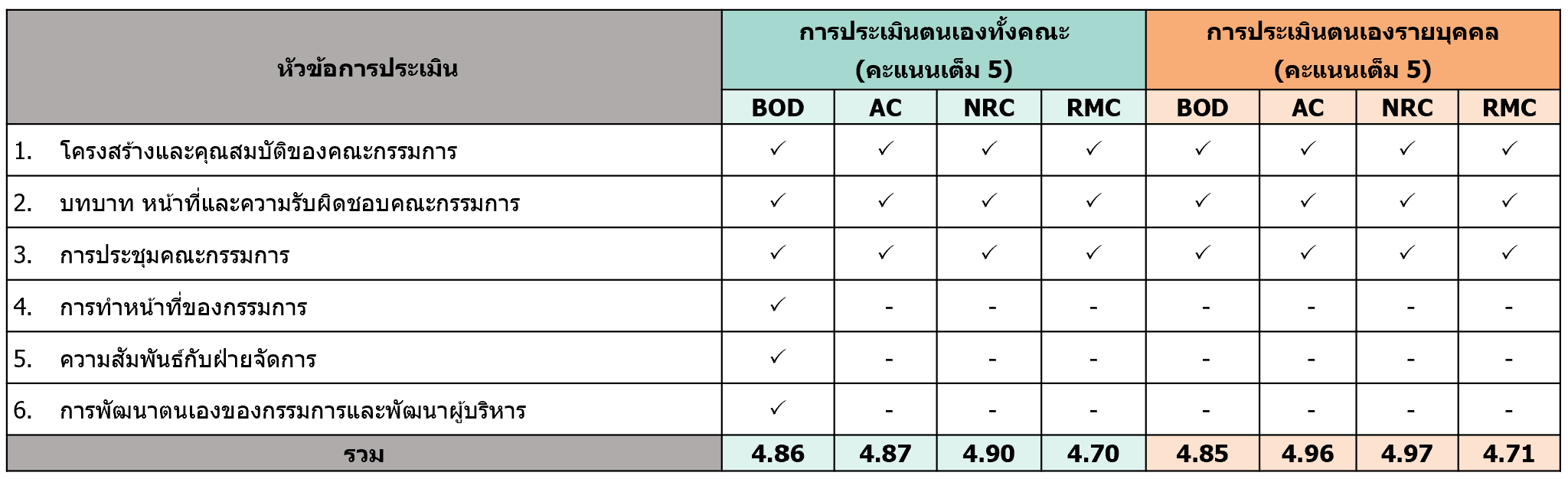
The Board of Directors mandates performance evaluations at least once a year to allow the Board to collectively review past year's performance and issues, and to utilize the evaluation results to improve and enhance the efficiency of their duties.
Types and topics of evaluation.
Evaluations are divided into 4 main types, with different topics for consideration based on roles and responsibilities, as follows:
-
Board of Directors (as a whole): Evaluated on 6 key topics, namely:
-
Structure and qualifications of the Board of Directors.
-
Roles, duties, and responsibilities of the Board of Directors.
-
Board meetings.
-
Performance of directors.
-
Relationship with management.
-
Self-development of directors and executive development.
-
-
Company directors (individual), sub-committees (as a whole), and sub-committee members (individual): Evaluated on 3 topics, namely:
-
Structure and qualifications of directors.
-
Board meetings.
-
Roles, duties, and responsibilities of directors.
-
Performance measurement criteria.
The company uses an evaluation form with 5 levels of measurement criteria, as follows:
-
1 point: Strongly disagree or no implementation of the matter.
-
2 points: Disagree or very little implementation of the matter.
-
3 points: Agree or reasonable implementation of the matter.
-
4 points: Quite agree or good/frequent implementation of the matter.
-
5 points: Strongly agree or excellent/regular implementation of the matter.
Evaluation of the Chief Executive Officer and President (CEO).
The Nomination and Remuneration Committee will evaluate the CEO's performance annually to consider adjusting the remuneration rate appropriately, with 10 evaluation topics including leadership, strategy formulation and implementation, financial planning and performance, relationships with the Board and external parties, personnel management and development, and product knowledge, among others.
Process and reporting of results.
The company has a policy to disclose the results of the Board of Directors' performance evaluation in its annual report (Form 56-1 One Report).
Evaluation of Board Performance in the Past Year
The Company Secretary's Office is responsible for distributing assessment forms to all directors for evaluation at the end of each year and preparing a summary of the assessment results to report to the Board of Directors for their acknowledgment and annual discussion. For the year 2568 (2025), the performance evaluation results of the committees are as follows:
-
The Board of Directors (both collective and individual assessments) received an average score of “Excellent”.
-
The Audit Committee (both collective and individual assessments) received an average score of “Excellent”.
-
The Nomination and Remuneration Committee (both collective and individual assessments) received an average score of “Excellent”.
-
The Risk Management and Corporate Sustainability Committee (both collective and individual assessments) received an average score of “Excellent”.
Subcommittees
Subcommittees
| Results of the Subcommittee's Duty Performance |
|---|
In 2025, the Enterprise Risk and Sustainability Management Committee performed its duties in overseeing the Company's operations to be appropriate and consistent with strategic directions, policies, and a risk management framework that covers both enterprise risks and sustainability risks. Key duties performed are as follows: Oversight of Risk Management Processes The Committee oversees that the Group of companies has risk management processes consistent with the COSO ERM 2017 framework. It reviews the criteria for assessing likelihood and impact, and defines the acceptable risk appetite to align with ever-changing circumstances. Assessment and Establishment of Risk Management Plans Risk factors are analyzed, covering both current risks and emerging risks, with an emphasis on sustainability risks (ESG Risks) and adaptation to the impacts of climate change. Appropriate risk indicators and control measures are also established to reduce the likelihood of future risks. Monitoring and Reporting The Committee regularly monitors the implementation of risk management plans to ensure alignment with the Company's objectives. Results are reported to the Board of Directors quarterly. Additionally, joint meetings are held with the Audit Committee to exchange information and recommendations regarding enterprise risk assessment and significant internal controls. Managing Challenges and Risk Diversification In 2025, the Committee has prepared to address price challenges in the ethanol and tapioca starch businesses, including production fluctuations in the supply chain due to climate conditions. Furthermore, it oversees risk management in newly invested restaurant businesses and considers opportunities to enter new potential businesses to diversify risks and create sustainable performance. |
Nomination and Appointment of Key Personnel
Remuneration Determination
Performance Evaluation
Corporate Governance and Shareholder Engagement
|
Meeting Attendance & Remuneration
Types of Remuneration of the Board of Directors
Policy and Criteria for Consideration
-
Appropriate Level: The Company sets remuneration at a level appropriate to the scope, duties, and responsibilities of directors in each position.
-
Benchmarking: Reference and comparison are made with listed companies on the stock exchange of similar business size or within the same industry.
-
Link to Performance: Remuneration (especially bonuses) will be linked to the overall performance of the Company to incentivize the Board of Directors to guide the organization towards both short-term and long-term goals.
Components of Remuneration
The remuneration for directors and sub-committee members consists of 3 main components as follows:
-
Monthly Remuneration: Paid only to the Board of Directors (BOD) and the Audit Committee (AC).
-
Meeting Allowance: Paid based on the actual number of meetings attended, covering both the Board of Directors and all sub-committees (AC, NRC, RMC).
-
Annual Bonus: Determined as appropriate based on the Company's performance each year and allocated according to the tenure of service.
Remuneration Rates (2025 Data)
Following the approval of the Annual General Meeting of Shareholders 2025, the rates are set as follows:
-
Board of Directors (BOD)
-
Chairman: Monthly 40,000 Baht / Meeting Allowance 25,000 Baht per meeting.
-
Director: Monthly 30,000 Baht / Meeting Allowance 20,000 Baht per meeting.
-
-
Audit Committee (AC)
-
Chairman: Monthly 20,000 Baht / Meeting Allowance 15,000 Baht per meeting.
-
Director: Monthly 15,000 Baht / Meeting Allowance 12,000 Baht per meeting.
-
-
Other Sub-Committees (NRC and RMC): No monthly remuneration; only meeting allowances (Chairman 15,000 Baht / Director 12,000 Baht per meeting).
Terms and Specific Characteristics
-
Limited to Non-Executive Directors: The Company's policy is to pay remuneration and bonuses only to non-executive directors. Executive directors (e.g., CEO) will receive remuneration as employees/executives as usual and will not receive additional remuneration as directors.
-
No Other Remuneration: The Company does not pay any non-monetary remuneration to directors.
-
Approval Process: The Nomination and Remuneration Committee (NRC) will screen and propose to the Board of Directors for final approval from the shareholders' meeting annually.
Remuneration or Benefits Payable to the Board
| Metric | Amount (Baht) |
|---|---|
| Remunerations or benefits pending payment to the board of directors over the past year (baht) | 0 |
Supervision of Subsidiaries & Associated Companies
Does the Company Have Subsidiaries or Associated Companies?
Yes
Is There a Mechanism for Overseeing Subsidiaries and Associated Companies?
Yes
Mechanism for Overseeing Management of Subsidiaries
Appointment of representatives as directors, executives, or controlling persons
-
Proportionate Shareholding: The company will consider appointing representatives to serve as directors or executives in subsidiaries or associates, at least in proportion to its shareholding.
-
Qualifications: The appointed individuals must possess full qualifications and responsibilities, and must not exhibit characteristics indicating a lack of trustworthiness, as per the announcements of the SEC Board.
Scope of authority and responsibility of representatives in setting important policies
-
Voting: Directors acting as representatives have the discretion to vote on matters of general management and normal business operations for the best interests of the company and its subsidiaries.
-
Approval Before Voting: For matters critical to management and business, representatives must present the matter to the company's Board of Directors for approval before casting their votes at the meeting of the respective subsidiary or associate.
-
Legal Duties: Representatives must perform their duties responsibly in accordance with laws, regulations, and company policies, and must not participate in approving matters in which they have a vested interest or a conflict of interest.
Disclosure of Financial Status and Operating Results
-
Monitoring: The Board of Directors will ensure that subsidiaries and associates disclose financial status, operating results, and other significant transactions to the company completely and accurately.
-
Information Channels: Appointed representatives are responsible for providing channels for the company's directors and executives to receive timely information from subsidiaries for monitoring their financial status.
Transactions between the company and related parties
-
Consideration Criteria: Transactions with related parties must have their size calculated and compared with the company's size according to the criteria of the Capital Market Supervisory Board and the Stock Exchange of Thailand.
-
Approval
-
If the transaction size meets the specified criteria, it must receive approval from the Board of Directors before the subsidiary can proceed with the transaction.
-
If it is a large transaction according to the criteria, it must be approved by the company's Shareholders' Meeting with votes of not less than three-fourths of the attendees with voting rights.
-
Other significant transactions
Transactions that are not part of normal business operations and have a significant impact must be approved by the Board of Directors or the shareholders' meeting (as the case may be), such as:
-
Borrowing, lending, or providing guarantees that are not part of normal business operations.
-
Dissolution of subsidiaries
-
Capital increase or decrease that significantly reduces the company's shareholding proportion or voting rights,
Acquisition or disposal of assets
-
Must comply with the criteria for calculating transaction size set by the Capital Market Supervisory Board and the Stock Exchange of Thailand by analogy.
-
Including the transfer or waiver of benefits, the sale or transfer of all or a significant part of the business, and the lease or hire-purchase of a significant part of the business or assets.
Internal Control Systems of Subsidiaries
-
Appropriateness and Prudence: The Board of Directors is responsible for ensuring that subsidiaries have appropriate, efficient, and sufficiently robust internal control systems to ensure that operations comply with the company's plans, budgets, and policies.
-
System Establishment: Directors and executives acting as representatives are directly responsible for establishing internal control systems and necessary operational systems, including measures to monitor the performance of subsidiaries.
Oversight Mechanisms
| Mechanism |
|---|
| Sending representatives to act as directors, executives or controlling persons in proportion to shareholdings |
| Defining the scope of powers, duties and responsibilities of directors and executives who represent the company in setting important policies |
| Disclosure of financial information and operating results |
| Transactions between the Company and related persons |
| Other important transactions |
| Acquisition or disposal of assets |
| Internal control system of the subsidiary operating the core business is appropriate and sufficient in the subsidiary operating the core business |
Board Duty Performance — Overview
Board Duty Performance — Overall Description
The Board of Directors performed its duties as stipulated in the Board of Directors' Charter, within the framework of good corporate governance, while adhering to the principle of Fiduciary Duty. This is a crucial principle in ensuring that the Board performs its duties with prudence, care, and integrity for the utmost benefit of the Company and its shareholders as a whole.
In 2025, the Company held a total of 8 Board of Directors meetings, with details as follows:
Organizational Structure and Corporate Governance Oversight
-
Changes in Directors and Executives: The Board considered and approved the appointment of new directors to replace those who resigned, and considered the re-election of directors whose terms expired, as well as the appointment of a new Company Secretary, to ensure continuity of operations.
-
Policy and Charter Review: Reviewed and approved amendments to 24 charters of various committees and company policies to align with good corporate governance principles and SET ESG Ratings assessment criteria.
-
Performance Evaluation: The Board of Directors and sub-committees received an "Excellent" performance evaluation, both collectively and individually.
Strategic Planning and Business Expansion
-
UBEYOND Vision: The Board approved the strategic plan and business direction for 2025-2030 under the concept of "UBEYOND," which focuses on growth through sustainable innovation and technology.
-
Food Business and Innovation Expansion: Approved key investment projects, such as expanding the product portfolio in the Ready-to-Eat category to elevate them to High Value Products (HVP).
Financial Oversight and Risk Management
-
Profit Allocation and Dividends: The Board considered and approved the payment of dividends from the 2024 operating results to shareholders at a rate of 0.0236 Baht per share.
-
Funding Procurement: Approved entering into long-term loan agreements to support various investment projects, such as ERP systems and warehouses.
-
Risk Management: Organizational risks are closely monitored and assessed, including strategic, operational, financial, and compliance risks, as well as emerging risks such as foreign import tax policies and cyber threats.
Internal Audit and Internal Control
-
System Audit: The Audit Committee oversaw internal audits of key processes such as procurement, sales, and payment collection, including the use of the SAP system to enhance transparency and reduce errors.
-
Correction Tracking: The implementation of corrective actions for issues identified during audits is continuously monitored to ensure the effectiveness of the company's internal control system.
Success from External Evaluation
-
The company received a perfect score of 100 from the Annual General Meeting (AGM Checklist) quality assessment project for 2025.
-
Continuously received a 5-star (Excellent) rating in the Corporate Governance Report (CGR) assessment.
-
Received an "AA" rating in the SET ESG Ratings sustainability assessment and outstanding scores in environmental and social aspects.
Audit Committee Duty Performance
Results of the Audit Committee's Duty Performance in the Past Year
Review of Financial Statements and Financial Reports
The Audit Committee reviewed the quarterly financial statements and the 2025 annual financial statements, which were prepared in accordance with Thai Financial Reporting Standards (TFRS). Meetings were held with the auditor and the accounting department to consider the accuracy of accounting policies and disclosures. Additionally, separate meetings were held with the auditor, without management present, to discuss Key Audit Matters (KAMs) and the independence of the audit work. The auditor issued an unqualified opinion on the 2025 annual financial statements, and the Committee believes that the financial reports are accurate, reliable, and fully disclosed.
Evaluation of Internal Control System and Internal Audit
-
Internal Control System: Reviewed in accordance with international COSO 2013 standards, covering all 5 components, with an emphasis on high-risk processes and information technology systems. The evaluation found no significant deficiencies, leading the Committee to conclude that the internal control system is adequate and appropriate.
-
Internal Audit Function: Overseeing the independence of the internal audit unit and approving the 2025 annual audit plan, which focuses on critical high-risk processes. The committee assessed that the operations were satisfactory in terms of efficiency and effectiveness.
Good Corporate Governance and Legal Compliance
-
The Audit Committee has overseen that the company's business operations comply strictly with the laws and regulations of the Stock Exchange of Thailand and the SEC.
-
No material issues of non-compliance with laws or regulations were found, including the opportunity for minority shareholders to propose agenda items in advance, though no proposals were submitted in the past year.
Intercompany and Connected Transactions
The reasonableness of transactions that may involve conflicts of interest has been reviewed quarterly to ensure compliance with general trade conditions and maximum benefit to the company, without any transfer of benefits, and with accurate disclosure of information as required by law.
Anti-Corruption and Whistleblowing
The Company strictly adheres to its anti-corruption policy, earning the CAC Change Agent award in 2025. Furthermore, it has overseen the whistleblowing channels, and according to reports from the Internal Audit Department, no whistleblowing reports or complaints regarding corruption or misconduct were found in 2025.
Consideration of Auditor Appointment
The Committee considered and selected the auditor based on independence, expertise, and appropriateness of remuneration, resolving to propose the appointment of EY Office Limited as the auditor for the year 2025.